460 | Building a Cohesive Product Line with Amita Nair, Amicreative
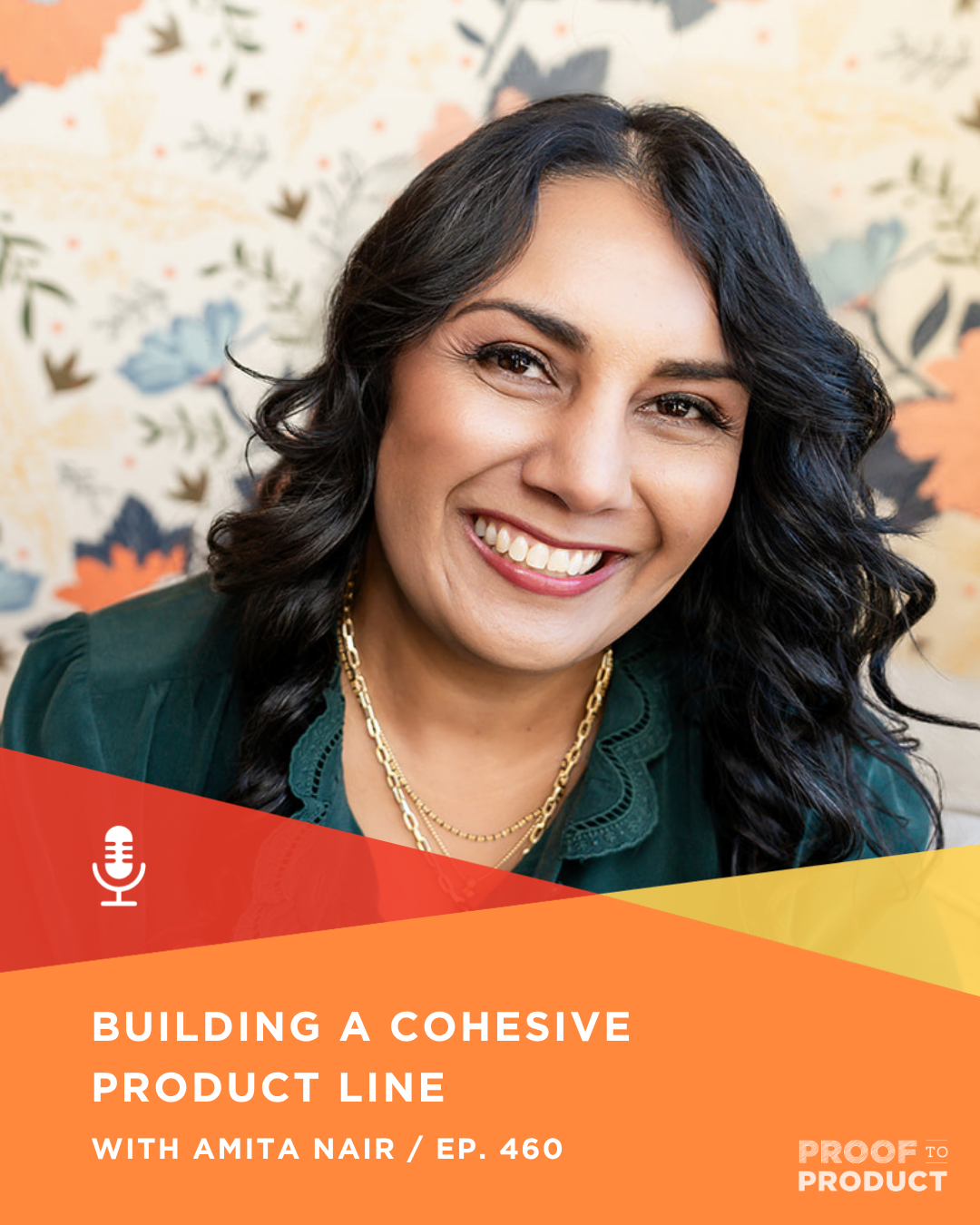
When you're deciding which products to add to your line, you probably think about your pricing or sales data first. But that's only part of the story.
Amita Nair has built Amicreative into a cohesive, intentional brand by making product decisions from four angles: financial performance, design aesthetic, what customers actually want, and whether the product fits her brand voice.
In this episode, she walks through how she's learned to say no to products that make business sense but don't fit her story—and why that clarity matters.
In this episode, you'll learn:
The four lenses for evaluating new products: data, design, customer voice, and brand alignment
Why Amita chose to add aprons instead of expanding into oven mitts (and what that decision reveals about brand strategy)
How licensing and product can coexist—and which one might take priority at different stages
The role of peer community in making better business decisions and avoiding costly mistakes
Why "I can add this" is different from "I should add this"
How starting with a small, cohesive product line scales better than chasing every opportunity
Ready to build a product line that's both profitable and true to your brand? If you're deciding which products to develop, what sales channels to pursue or how to grow your product based business, LABS gives you access to the peer community and resources you need to make those decisions with confidence.
MEET AMITA NAIR
Amita Nair is the artist, illustrator, and founder of Amicreative, a stationery and gift brand inspired by her Indian heritage and the natural beauty of the Pacific Northwest. Known for her richly detailed, hand-illustrated artwork, Amita creates greeting cards, gift wrap, journals, home goods and gifts designed to bring joy, connection, and meaning to everyday moments.
What began as a creative business designing custom wedding invitations evolved into a product line carried by independent retailers across the United States. Her artwork has also been licensed by brands including TJX, Geometry Home, and Fringe Studio.
Over the years, Amita has grown Amicreative through wholesale, licensing, trade shows, and direct-to-consumer sales, exhibiting at industry events including NY NOW, Atlanta Market, and SURTEX.
In 2025, she received a Louie Award from the Greeting Card Association for her Lunar New Year greeting card design and was also nominated for Artist of the Year.
Passionate about the business side of creativity, Amita enjoys sharing her experiences navigating wholesale, licensing, marketing, and entrepreneurship while encouraging fellow artists to build businesses that reflect their unique voice and creative vision.
CONNECT WITH AMITA NAIR
WEBSITE: shopamicreative.com | INSTAGRAM: @amitanair
your product brand right now?

Connect with Katie Hunt
Katie Hunt is a business strategist, podcaster, mentor and mama to four. She helps product based businesses build profitable, sustainable companies through her conferences, courses and coaching programs.
Website: prooftoproduct.com | Instagram: @prooftoproduct
-
Katie Hunt [00:00:00]:
Hey friend, welcome back to Proof to Product. Today's guest is Amita Nair, the founder of Ami Creative. She also happens to be one of our Paper Camp alumni and a member of my advisory board mastermind. Amita's a surface pattern designer and a product maker who creates stationery, gifting products, and soft goods. Everything from greeting cards to aprons to enamel pins, all inspired by her Indian heritage and the Pacific Northwest where she lives. She has been building this brand since 2019, and today we're going to talk about how Amita has curated and built a cohesive product line that's not just based on her design style, but also data points, customer feedback, and the values that her brand stands for. We will talk about how she curates her product line, including how she decides whether to move into new product categories, what to add, what to skip, and how she thinks through these decisions from multiple angles. We talk about how Amita balances different arms of her business, specifically leaning into the licensing arm of her art and creating and selling her own products.
Katie Hunt [00:01:05]:
We talk about why she went back to grad school to become an illustrator and why building your brand story matters just as much as adding more SKUs to your collection. We also talk about how being a business owner can be lonely sometimes and how Amita has leaned on our Proof to Product community as well as other design communities to support her business Today's episode is brought to you by Proof to Product Labs. If you are building a product-based business and you feel like you are spinning your wheels doing it all alone, Labs provides a community of supportive creatives who are working towards similar goals, plus trainings and coaching to help you move through that messy stage of business more quickly. Head to prooftoproduct.com/labs to learn more about our community, what folks are working on, and how you can get the support you need. Again, that's prooftoproduct.com/labs. I'm Katie Hunt, wholesale expert, business strategist, and mom of 4. I'm also the host of the Proof to Product podcast. Since 2011, I've coached thousands of brands whose products can be found on the shelves of indie shops and big box stores all around the world.
Katie Hunt [00:02:13]:
If you are a creative entrepreneur that makes and sells physical goods, you're in the right place. Here on Proof to Product, you'll learn new strategies for product development, sales, marketing, and more. It's like your weekly dose of business school, and we're going to help you confidently grow your revenue in your own way and at your own pace. So let's get started. Hey, Amita, welcome to Proof to Product. Hi, Katie.
Amita Nair [00:02:40]:
Thank you so much for having me.
Katie Hunt [00:02:41]:
I am really happy to have you here. I have been a long admirer of your products and your design aesthetic. But also how you've made like super intentional shifts in your business over the years, which is kind of what I want to focus our conversation on today. So first, let's tell the listeners about your business. What led you to start this business and what types of products do you sell?
Amita Nair [00:03:01]:
My business is AmiCreative and I create stationery, gifting products, and artwork that's all inspired by my Indian heritage and the Pacific Northwest where I live. My product line includes stationery, so I have greeting cards, I have notebooks, I have wrapping paper as well as like gift tags and gift bags. I also have soft goods, including aprons and tea towels, and I have gifting products, including keychains and enamel pins.
Katie Hunt [00:03:31]:
It's such a different assortment of product, but yet everything looks so cohesive and beautiful together. I'm sure that was intentionally built, but like, what was the first thing you started with? And then how did that expand through the ranks?
Amita Nair [00:03:43]:
As a surface designer, all of the illustrations are my original illustrations, and I try to— I have a pretty narrow color palette. And since all of my inspiration comes from the same place, everything's pretty cohesive.
Katie Hunt [00:03:56]:
Yeah, it really is.
Amita Nair [00:03:57]:
The first products I had were cards, 5 by 5 cards, which I quickly learned in Paper Camp were not the right size.
Katie Hunt [00:04:04]:
I didn't realize you did square. You and Janine both did square at first.
Amita Nair [00:04:09]:
Yeah. And this was before I— so I started my line before I took proof to product. So I did it. And it did work. And then I took Paper Camp and I was like, oh, that's why. So I had the square cards and then I had mugs actually was the first thing I did. And I did some notebooks and pins. There was 3 enamel pins that I started with.
Amita Nair [00:04:31]:
That was kind of my product line. Those were the things I started with. Then I did my first trade show in 2019. It was a really small Seattle one. So those are the 4 categories I started with at that point.
Katie Hunt [00:04:44]:
How'd you do at the first show?
Amita Nair [00:04:46]:
Better than I thought. I got 3 orders and it being the very first catalog I put together and my first try at it, it was good. I had only started actually doing product about 6 months before, so I was pleasantly surprised when I got my 3 orders.
Katie Hunt [00:05:03]:
We have such an overlap in our stories. I went to my first show 6 months after making my first product line. I got 3 orders at my first show in New York and I was like over the moon excited because I had no idea what to expect. I just wanted at least one. Yeah, but also at the same time, like, I don't know, you at least did a local show, right? You were in Seattle and you were living there at the time?
Amita Nair [00:05:24]:
It was Seattle.
Katie Hunt [00:05:26]:
Okay.
Amita Nair [00:05:26]:
Yes, yes, it was Seattle. It was local and it was very much my first day. I didn't even know what a fair was. The person next to me was talking about it. I was like, oh, what's that? I should get into that.
Katie Hunt [00:05:37]:
Indigo Fair back then, I think. I think they were still Indigo Fair then, right?
Amita Nair [00:05:40]:
Yeah, yeah.
Katie Hunt [00:05:42]:
Oh, that's hilarious. Had you been doing licensing before that though? 'Cause you have a pretty robust licensing portfolio too. So you started with product?
Amita Nair [00:05:51]:
For a long time I was a graphic designer and then I started doing wedding invitation design. And so I was doing a lot of freelance work. I was doing branding as well as event and wedding stationery. And then after a while I realized a lot of my artwork would translate to products. And so, that was why I decided to do product first. And then, I decided I needed to go back to school because if I was going to do product or all of these things— like, I had a graphic design background, but I decided I need to go back to school and actually be a real illustrator. To do that, I need a degree. Maybe that's the Indian in me, but— So, I went back.
Amita Nair [00:06:32]:
And then, when I was in grad school, I was talking to one of my professors and she was looking at my work and she's like, well, You're a surface designer. Like, all of these things that you're doing and all of these patterns that you're making for these wedding invitations and stuff, she's like, that's clearly what you enjoy doing, and that's surface design. I had never heard about it. And so that was kind of concurrent to me building the product lines because that was around probably the end of 2019, beginning of 2020.
Katie Hunt [00:06:59]:
Okay.
Amita Nair [00:06:59]:
So it was kind of both things at the same time. I was doing the product, but then when I discovered surface design, I was like, oh, Licensing. That sounds really interesting because there's less of a financial investment.
Katie Hunt [00:07:09]:
Right, exactly.
Amita Nair [00:07:11]:
So it was kind of— it was about the same time that I started doing that too.
Katie Hunt [00:07:14]:
Very cool. Okay, so did you try to build both engines at the same time? Were you like actively building the product line and also pitching to licensing deals?
Amita Nair [00:07:24]:
I did, and it was, it was not the best choice.
Katie Hunt [00:07:28]:
Well, I'm not criticizing you. That's a lot to take, especially you have 3 children at home that you were also This timing you're talking about was pandemic timing too. So this is a lot going on.
Amita Nair [00:07:38]:
I was trying to build both at the same time because a lot of the artwork that I was creating for licensing was the same ones that I was putting on my product. But I found that licensing is kind of where I was having more traction. And so I was putting more energy into that. And so the product side was, it was a lot slower. And so mostly I was focusing on kind of licensing and building out these larger collections because For things like fabric and stuff, the collections are larger, so you're looking at like a lot more artwork. So that was one of— it was probably more towards licensing in the beginning is what I was focusing on.
Katie Hunt [00:08:15]:
That timeframe too. So let's talk about that. You have 3 kids at home, you're entering the pandemic, you're building the product line, you're pitching your art to licensing prospects. On a lot of levels, that licensing side was probably logistically easier given that you had all these kids home and there wasn't the upfront cost of inventory. I think it may— it was a smart move to like kind of focus on that more so, or do it in tandem, but do the licensing more quickly and more thoughtfully implementing on the product side.
Amita Nair [00:08:44]:
It was very strategic. I, at that point, was on Faire. And so it was easy for me to put products up on Faire, but I wasn't really doing as much of the pitching and stuff because I decided to do that more on the licensing side, just because of the cost, but also just the time. It was easier for me to research and do that side of it. So yeah, the cost is so much less in licensing, at least for me.
Katie Hunt [00:09:08]:
It's a longer lead time though, don't you think?
Amita Nair [00:09:11]:
It is. It's a much longer lead time. You don't have as much control over the terms and what you're actually— as far as I've found, for me, I found that you don't have as much control over how much you're actually going to make. Whereas after a couple of years, I realized with products I could see the numbers. I knew exactly what I needed to do. I could see what I was selling. And also I could see what my audience wanted, right? Like, I could see what people were coming to me for, and I knew where to lean in. Whereas with licensing, it was a little bit more— I just wasn't getting those data points.
Amita Nair [00:09:43]:
And so it kind of became like, okay, I'm making what I like, I'm making what I think will work, but you can't necessarily see the return on it right away. And so that was kind of my switchover.
Katie Hunt [00:09:55]:
That makes a lot of sense. And also too, on the licensing side, it can be great, a revenue stream for a lot of folks, but it is a long lead time. You'll pitch something now that may not go into production a year or 2, you know, and then you don't get paid far after that too. So, I mean, I'm generalizing the process here for our listeners, but, you know, but, you know, it's, it's very different than receiving a wholesale order, shipping out the product and, you know, getting paid. So.
Amita Nair [00:10:18]:
Yes, yes, it's very different. And then I will say though, my brand and my aesthetic is very specific. And so I found that, and it's true for both my product line and for my licensing, but I have a very specific audience. And so finding that audience in the licensing world is a little bit more difficult, I guess.
Katie Hunt [00:10:40]:
Interesting.
Amita Nair [00:10:41]:
I found after a while, because some of my artwork just didn't necessarily translate to as many products as I expected them to. Whereas for product, it was easier for me to make it cohesive and find the exact audience that would buy. And so, yes, a lot of time was spent on licensing and I still do licensing and it's still, it's still definitely a leg of my business. But I found it to be more difficult than product.
Katie Hunt [00:11:06]:
I also feel like there's seasons, at least what I've seen with myself and other clients. And I don't mean seasons for selling licensing or seasons for selling product. I just mean like there's certain times where I was like really into the licensing art I was creating and creating that, you know, enhancing my portfolio. And then there were other times where I was like, I'm really enjoying designing all this product and I just want to like work on my sales strategies and my marketing emails. And like, you know, the data side of me is like nerding out on the stats.
Amita Nair [00:11:33]:
Yes. Yes.
Katie Hunt [00:11:34]:
You feel that too?
Amita Nair [00:11:35]:
Yes, I definitely do. And I actually really enjoy— I mean, I love creating the artwork. I'm an artist, but I really enjoy putting a product together, like actually bringing it to life and working out exactly what it's going to look like, how it's going to work, whether it's the front, the back, or what are all the pieces of it. I really enjoy that. And with licensing, there's not necessarily that aspect, right? It's very much create your artwork, you put it out there, and you'll talk with Whoever you're licensing with. But a lot of times they have an in-house— they have in-house people who are doing that aspect. So yeah, it kind of also just depends on my mood because sometimes I do want to just create art and have someone buy it and be done with it. Right.
Amita Nair [00:12:16]:
I know.
Katie Hunt [00:12:17]:
Yeah. You go create this product that I probably would never manufacture, but I would love to see my art on. Right. Well, let's talk about your design style because as you mentioned, it's deeply influenced by your Indian heritage, but also your love of Pacific Northwest where you live. How did those 2 influences come together into one kind of brand identity? Because your brand is really solid. What you talked about is, I mean, for folks listening, please go check out Ameeta's website because the colors you use, the styles you use, it is a very cohesive, very strong brand style and influence there. So did that take time to develop? Did it happen quickly for you? What's, what was that like for you?
Amita Nair [00:12:55]:
It took a little time. So The way that I bring both things in is a lot of my— the icons, the imagery I use, there's a lot of nature, there's a lot of plants and florals. And then the line work I use is very inspired by traditional Indian artwork. It's also kind of inspired by or influenced by my graphic design background as well as I was born and raised here in Southern California. I'm still a Valley girl at heart. And so I grew up in a household where we were kind of celebrating everything. We were celebrating all of our Indian holidays, but also I love Halloween. I'm a big fan of Halloween.
Amita Nair [00:13:33]:
And so my art style is very influenced by taking the colors and a lot of the textures and details that I find in traditional Indian artwork and even in modern Indian artwork. A lot of the motifs and kind of the shapes, I also see a lot of similarities between that and modern art and kind of simplistic shapes. And then having moved here, I've lived in a lot of different places. I've lived in New York, LA, a lot of different places. But now being here, it's great. I can go outside and go on a hike at any time. And so there's a lot of just nature. And I try to bring in a lot of shapes and flowers and different things that I see kind of just in my everyday life going out on hikes and Reinterpreting them through a lot of the traditional things that I've grown up with as far as color, as far as line work, and making it cohesive.
Amita Nair [00:14:27]:
Because I think that— I think there is a lot of cohesiveness in it because it's all influenced by the way that you see things. And for me, a lot of it kind of comes back to nature and just being outside, whether it's the animals that I see here or the animals that I see in— Like traditional artwork. And then I try, I do try to pull in other cultures as well, kind of depending on the piece that I'm doing. Like when I do something like Lunar New Year, I'll do research there and figure out kind of what are symbols that are traditionally used, what are the colors and why, and make sure that I'm trying to kind of bring that in too.
Katie Hunt [00:15:04]:
I'm captivated by everything you're saying, Amita, because you are so stinking strategic about the products you create, the art you create, how you take even these influences in your life from different areas and bring them into your work. I mean, all of us are influenced by the things in our lives, and that affects what we create, right? But you do it so beautifully and so, again, cohesively. There's a lot of folks out there with product lines that look very different as they layer in new products, and yours doesn't. And I think that benefits you greatly, and I think it speaks volume to your design eye and your talents there. And so just, I want to give you some kudos on that because I think having a— you're welcome. I think having a cohesive product line is something that everyone strives But it doesn't come easily to most people. And you make it look easy. I'm sure it's not easy, but you make it look easy.
Amita Nair [00:15:56]:
Yeah, I will say that what I started with was very different. But the— my first catalog was a lot of black and white. A lot of the imagery I actually still use, like the way I illustrate a bird, you'll see is the same. The way I'll draw an elephant or a leaf or something are the same. But I've been very intentional with making sure that I'm spending a lot of time really thinking about colors. And when I add that in, it took me a long time. It took me a couple years of trying new things. And then I found that when I stuck with certain colors, it just felt— part of it was just it felt better.
Amita Nair [00:16:34]:
It felt more like what I was actually trying to achieve. And then once I started realizing, oh, that's— once I— it was very much a, oh, Those 3 colors really work. Like, this is what I've been trying to do. And then I tried to really spend time figuring out what it was about that that worked and leaning into that. And so that process definitely took a little while. And now I feel like— now I feel like I've gotten there. But like I said, I started my product line in 2019 and now it's 2026. And I feel like in '25, was really where I was like, oh, this is my product line.
Amita Nair [00:17:13]:
That— so that's kind of— that's how long it took me to feel like this is it.
Katie Hunt [00:17:17]:
So you felt like it took a long time for it to settle down. Lots of ideas floating, lots of experiments happening, but you felt like you came to what you have now like a year ago. Interesting.
Amita Nair [00:17:27]:
Yes, exactly. That's definitely how long, because it was last year that I was able to look at everything, and I spent a lot of last year cutting a lot of things.
Katie Hunt [00:17:35]:
Yeah, talk about that. You've discontinued a lot of different products.
Amita Nair [00:17:38]:
I've discontinued, well, a lot of designs and definitely some products, and there's some that I'm still trying to get rid of.
Katie Hunt [00:17:46]:
Girl, I still have some on my shelf from Kelp Designs, and I closed that business 10 years ago.
Amita Nair [00:17:52]:
But there's definitely— it was a lot of looking at everything, and part of it was definitely sales numbers. Part of it was definitely looking at numbers and saying, okay, this category or this type of artwork is what sells, because I definitely in my brand It's funny that you say it feels cohesive because when I look at it, I still categorize things and say, okay, this is really a floral, this is another category. But looking at everything, there were certain things where I was like, that is just not what I want to create anymore. Like, that just doesn't feel like me. And so it was very much taking everything and putting it out in front of me and looking at all of it together. And then I was able to pinpoint and say that this is not really what I want to be making. And then as I pulled those things out, I was able to look at that group and say, oh, this is what's off about this and this is what is working about this. And it comes down to kind of color for me.
Amita Nair [00:18:45]:
It came down to some of it was kind of just mood. Like if you look at my products, I have, I try to be, or it is very moody at times, earthy. And so I was realizing as I looked at everything and as I was cutting things that certain things just didn't fit those categories and didn't feel the same.
Katie Hunt [00:19:04]:
And that's totally normal. That's total— yeah, that signifies growth, right? Like we've outgrown certain styles or products or— so I, I think it's great that you're recapping this for our listeners because they're probably going through similar phases right now on their own.
Amita Nair [00:19:17]:
Yeah. And it was a long year. Like last year was a lot of different changes, a lot of things that I thought I was doing that I didn't do. But coming out of the other side of it, I was like, that was definitely worth it because now I can look at my brand And I will say, for a long time people have said, oh, your stuff feels very cohesive and you've got a very specific viewpoint and stuff, but I necessarily wasn't seeing it. And now I can look at having gone through that practice, now I can see it. And now I say, yes, I can see it. And not only that, but I'm able to actually identify things. And so now I've got like— Now I've almost got a framework where as I'm creating artwork and stuff, I can look at it and say, Does it hit these markers? Because if it doesn't, maybe it belongs in my licensing portfolio, but it's not something I'm going to turn into product for my brand.
Katie Hunt [00:20:06]:
I love that. What kind of framework or what kind of like metrics or not metrics, what do you call them? Like what kind of criteria are you trying to hit then to make that decision?
Amita Nair [00:20:16]:
Definitely color.
Katie Hunt [00:20:18]:
Color is what I think of most with your line. And I think that's why folks, including myself, think it's so cohesive because it's a beautiful palette and it's carried throughout everything. But go on, I cut you off. I apologize. Oh no, it's okay.
Amita Nair [00:20:29]:
Definitely color as well as some of the other things from a design point of view would be like spacing. Like, does it feel as— I don't know if maximalist is the right word, but does it feel as rich as I want my brand to feel? Like, are there— is there enough going on that you look at something and you spend some time looking at it because there's so much detail?
Katie Hunt [00:20:51]:
Because you're so curious about it.
Amita Nair [00:20:53]:
Right. Or is it something that is nice to look at, but you kind of move on quickly? Or not move on quickly, but like you see it and you think it's very nice, but it's not necessarily going to draw you in. That's something that I think about. Some of the other things I think about is just what is it like? Animals. I have a lot of animals. I have a lot of florals. But there could be something like, honestly, you're probably not going to see a Santa in my line. I've drawn Santas and I have Santas in my licensing portfolio, but my brand, it's not really an icon that I would probably create.
Katie Hunt [00:21:27]:
Right.
Amita Nair [00:21:28]:
For me, for holidays, I, you know, I just came out with my holiday illustrations. I have wreaths, I'll have reindeers, I'll have cabins, you know, because I think all of those go back to my line, the cabins with the Pacific Northwest, the reindeer, the animals, but a Santa doesn't necessarily fit there.
Katie Hunt [00:21:47]:
Right.
Amita Nair [00:21:48]:
So that's some of the things that I look at.
Katie Hunt [00:21:52]:
This is great. I think it's super helpful for people to hear how you interpret— well, one, it sounds like you're not limiting what you're creating with your art. You're just creating, and then you're kind of seeing, okay, where does this fit and how do I leverage this asset that I've created? Do I put it in with my licensing portfolio? Do I maybe make it into some of the products? And I love that because, you know, you're thinking strategically and thoughtfully, but you're also having fun, it sounds like, in creating the art that you're creating and doing what feels right. So that's really great. Switching gears a little bit here. I know that you spent about a year preparing to move your product line to a 3PL for fulfillment. And I know you were like researching, planning, getting quotes. I don't know if you signed an agreement, but you decided not to move forward with that.
Katie Hunt [00:22:37]:
And I would love for you— well, first off, that takes courage. But secondly, do you mind sharing a little bit about that story? Because I think it would benefit others too.
Amita Nair [00:22:46]:
So I'll say that one of the things that, as much as I love product, one of the things that I hate, I hate packing orders. I hate—
Katie Hunt [00:22:53]:
That's good.
Amita Nair [00:22:55]:
So I had all my products in-house, like in my house, kind of everywhere. And then I moved it all into a storage unit because there's just a lot. When I started doing soft goods like aprons and tea towels, and when I mostly those, when I started doing those and a few other things, I just, I needed more space because I'm ordering internationally. So I'm ordering a lot more of everything.
Katie Hunt [00:23:16]:
Yeah, significant amount of product.
Amita Nair [00:23:18]:
So that's why I moved into a storage unit, but I dreaded going to the storage unit. Like, it made me cringe. And I will say that definitely affected my business because my orders weren't going out as fast, as efficiently as they should. And so kind of taking a step back, there were points where I was like, I think this whole business needs to close. I looked at what really was the pain point and it was definitely the fulfillment. And so that's why I thought, okay, I need to move into a 3PL. I need to move so someone else is doing all of this because I don't want to touch it.
Katie Hunt [00:23:50]:
Yeah, remove that friction.
Amita Nair [00:23:52]:
But to do that, you know, I had to do the research and I had to look at the numbers. I spoke to 3 or 4 different people and I got the numbers and a lot of the numbers definitely didn't make sense for me. I was like, I'm gonna lose money, but Is it a risk that I should take so that I can grow, right? So that I free up that much time and now I'm spending more time doing the marketing and all of the other things I should be doing. So there was a part of me that was like, well, I can kind of COVID my costs most months, but is it just a calculated risk? So I spoke to 3 or 4 different people. There was someone that I did actually sign a contract with that was close to me because A lot of the moving the stuff itself is an investment, right? Getting all of your product over is such an investment. And so I found someone that was here in the Pacific Northwest so that that cost at least was a little bit lower.
Katie Hunt [00:24:47]:
And if there were any emergencies or anything, you could get there quickly too.
Amita Nair [00:24:50]:
Exactly, exactly. And so I did all of that research and then came the part like, okay, I've decided someone, now I have to actually get it ready to Go there, right? Because I was very much like, I'd get an order and I'd go through the boxes and I try to be very organized, but there's always— it never ends up being as organized as I wanted it to be.
Katie Hunt [00:25:12]:
I hear you on that and I will let you have that, but I will also say you are very organized, so do not sell yourself short on that.
Amita Nair [00:25:19]:
But there was always the intention that I was going to have this many cards sleeved and ready to go at any one time, that those numbers never happened, right? Because there was always that, but I have to get these 20 orders out first before I actually get to prepping. And so to move into the 3PL, there was— I have to now spend 6 to 8 months or however long, or it was a good— maybe it was just about 6 to 8 months of like actually getting my products ready from— I luckily went with someone that didn't need everything skewed, but they did want everything kitted, which makes sense, right?
Katie Hunt [00:25:54]:
And it'll cut down on your costs if you guys are doing it in-house versus sending it to them to do.
Amita Nair [00:25:59]:
Yeah, exactly. So that meant going through and sleeving all the cards, getting them in groups of 6, banding them, kind of setting everything up.
Katie Hunt [00:26:06]:
Yeah. And also, just for the listeners, you have multiple product categories. So it's not just—
Amita Nair [00:26:12]:
Yes.
Katie Hunt [00:26:13]:
The cards, you know, put in 6s. It was— there was nuance to each of the categories you were selling.
Amita Nair [00:26:18]:
Yeah, there definitely was. Like, so I sell wrapping paper. And at the time, I was selling wrapping paper 2 ways, either as flat sheets and as rolls. And that made sense because I had people asking me for both. And on Faire, it's easy enough to put that in Faire in my catalogs to pitch people, because when I get an order, I could do either one right as I'm getting the order. The problem is that doesn't work for 3PL. It can, but now you're talking about 2 different SKUs. You're talking about different storage, different square footage that I'm paying for.
Amita Nair [00:26:52]:
And so I got rid of the flat sheets and it became everything is rolled. But that means now I'm rolling thousands and thousands and thousands of rolls all at once so that I can get it to them because I don't want to pay them to do it. I could have, but that would be eating more of my profit that I'm already losing between fare and sales reps, whatever else. So it was a lot of sleeving cards or getting the wrapping paper or packaging pins. It was a lot of all of those things. And At that time I had about 300 SKUs. So it was a lot.
Katie Hunt [00:27:23]:
That's significant.
Amita Nair [00:27:24]:
Yeah. After I did all of that, I looked at the numbers again and I was like, does this actually make sense?
Katie Hunt [00:27:30]:
Well, I'm sure you went— I don't mean to interrupt again, but like, I'm sure you went in looking at like, okay, what is my cost per square footage at the 3PL? What are the different costs for them to actually do this? But I don't think everyone thinks about what you have to do on the back end of your business to prepare the product to go to the 3PL. And I'm glad you're sharing this because There is a significant amount of work to do, and it's even more so when you have more product categories and more SKUs. So you reran the numbers again with some of these other details you hadn't thought about before?
Amita Nair [00:28:01]:
Well, it was 2 things. I reran the numbers looking at, okay, I just paid all of these people to help me get all of this stuff ready, as well as just the hours it took me to go in every day and do this. And then I was like, I've already done the hard work.
Katie Hunt [00:28:15]:
I can do this now. I can ship these orders out.
Amita Nair [00:28:17]:
Oh, I already took the time to get everything ready. So now I can actually just do this myself and not spend as much time, like not spend as much time where every time I get an order, I'm like, okay, for this group of orders for today, I am sleeving these 300 cards to get them out the door because everything's already kind of ready for me. And then it was the, it was definitely going to take thousands of dollars just to get to the 3PL.
Katie Hunt [00:28:47]:
Yeah. Just to move it all there. Right.
Amita Nair [00:28:49]:
because I can't fit everything in my car, right? It would have been a lot of driving back and forth, or I'd just do it all at once and send pallets. But then I was like, and what if it doesn't work out? If it doesn't work out, then I'm spending all of that money again to have it shipped back to me. And so it was definitely looking at those numbers, I'm like, this just doesn't— it doesn't make sense. And I also felt like I've already done the hard work. Like, I've I thought my problem was filling orders and the fulfillment side, but I was realizing that it was actually getting everything prepped. It was the prep that was killing me. Not to say that—
Katie Hunt [00:29:28]:
That's valid.
Amita Nair [00:29:29]:
Yeah. Not to say that I don't— I still hate going to storage. I still, like, when I get my orders and I— when I go, I still cringe every time I have to, like, start packing my boxes. I just don't Enjoy it.
Katie Hunt [00:29:43]:
But that's also solvable, and you're bringing on more help for that.
Amita Nair [00:29:46]:
Exactly. But I did hire an employee, and she's been amazing. And I know that there's the capacity now that I can hand this off to her. Like, she's doing such a good job right now just getting product ready that she will definitely not have an issue with this. So I found that my problem was not exactly what I thought my problem was.
Katie Hunt [00:30:08]:
Yes, which— that's so helpful to hear, though, because So often we do think the problem is one thing and then we start to solve that problem again, thinking that's what needs fixing, only to realize there's something else going on that we need to do. So I, I'm glad you discovered it when you did so that you could pull out of that contract and just move forward with how you have moved forward.
Amita Nair [00:30:30]:
Yeah, yeah, definitely. It was frustrating though, because I spent a year getting ready and then I started this year and I was like, oh, I spent all of this time.
Katie Hunt [00:30:39]:
Now I gotta pack orders again.
Amita Nair [00:30:40]:
Getting ready for this and it wasn't worth it. Like, I didn't end up doing it. And then also like with different products and stuff, it was like I spent all this time thinking this is the product that I was going to sell and stuff. So it's definitely, there's definitely a little bit of a range of emotions. Like I was happy that I had solved the problem, but it was also kind of frustrating. Like, oh, this was my plan for a whole year and I was going to start this year off like this and I'm still not actually there. But I realized it's also a matter of perspective. Like, okay, this is everything I did solve.
Amita Nair [00:31:11]:
Now it being August, I can say that, but definitely not how I felt in March.
Katie Hunt [00:31:16]:
Not how you felt in January or March.
Amita Nair [00:31:18]:
January, March, not how I felt like, oh, all of last year was wasted.
Katie Hunt [00:31:22]:
Well, I also have to imagine there's all of us kind of suffer from a sunken fallacy feeling too, where it's like, I've invested all this time and energy into moving my business in one direction. And so now that I'm pulling back, like, was that wasted? But everything you did to prepare for that actually benefited you with your internal shipping and fulfillment. But still, I understand the mindset shift that has to happen from like, okay, I'm shifting gears now. It wasn't lost time. It wasn't a waste of money or energy. You know, we're just kind of having to rethink how you, how you feel about that.
Amita Nair [00:31:55]:
I think that mind shift is something that I've realized is really important running my business. I have to be willing to, like, I have to constantly In lots of things, like take a step back and be like, okay, what did you actually accomplish? Maybe the goal needs to change. Maybe it wasn't this that you were actually working on. And that being able to make that shift and taking that step back, I think, is why I still have my business. Because there were lots of times where I would have been like, I'm done, I'm not gonna do it.
Katie Hunt [00:32:23]:
Well, let's talk about that a little bit more. Because I think that's really important. We hear a lot of stories where people push through. I know I'm guilty of that too. Like I just push through because that was what I set my goal at. And I'm gonna go hit that goal, right? Even if the goalpost has moved and it's really no longer what I need to be doing. We talked at the front of this episode, like, intentionality is what I really admire. I mean, I admire a lot of things about you, but like, you've been very intentional in your product line, your art that you've created, the decisions you made in your business, your leadership within the business.
Katie Hunt [00:32:53]:
What other things have you like intentionally pulled back on or changed your mind about to maintain that integrity and that intentionality?
Amita Nair [00:33:03]:
I feel like it's very easy to see a lot of what other people are doing. You know, there's certain things that are very popular right now. There are certain things that everybody's doing. It took me a few years to take a step back and say, no, just because that person is doing that, that's not necessarily the right thing for me. And it's tough when you see that the person's making profit on it or like—
Katie Hunt [00:33:23]:
Or they're saying they're making profit online.
Amita Nair [00:33:25]:
Yeah. Yeah. Or basically, like if I had a product, right, I have this product. And so it would make sense, like I have greeting cards and turning that into like other products like note cards or something like that. A lot of the advice I was given from different places and a lot of the different things I thought about doing were, okay, well, if I'm— if this is working, then I should turn it into this, this, and this product because then I'm using it and this person's already buying this from me.
Katie Hunt [00:33:55]:
Offer as much as possible with that one piece of art, right?
Amita Nair [00:33:58]:
Exactly right. Which definitely makes sense. And I definitely do do that. I do use it on different products, but I did have to take a step back and realize, do I actually want to offer that product? Like, does that product actually make sense for what I want to sell and what I want my brand to be? And also, is that really what the customer is looking for from me? Like, so I will say my soft goods, my aprons and tea towels, I did these because I really wanted to do them. I did aprons because I really wanted to do aprons. I use aprons. I love the idea of aprons because I think that a lot of what my brand is about is bringing art into your home, using it in your everyday, like making everything, even those menial tasks like cooking for your family when you don't want to, or, you know, things like that, making them feel elevated and making them more joyful. And so that was kind of my intention with aprons, like Yes, there's towels and stuff in your kitchen, and that's kind of about making your house feel beautiful or your kitchen feel lovely.
Amita Nair [00:35:03]:
But I felt like an apron is different. An apron is something you put on yourself. An apron kind of just makes you feel special. Like, I have to do this, but I'm going to do it in a way that I want to, or like, you know, right. Enjoy it.
Katie Hunt [00:35:14]:
I have to feed everybody again. At least make me feel good about it.
Amita Nair [00:35:18]:
Right. And so that was why I did aprons. And then I did the tea towels because that's what people actually sell. When I did aprons, there were not that many people selling aprons. And then I added the tea towels because I was like, that's actually— that's what people are actually buying. And so it's a set. And so it made sense. But from there, it would have made sense.
Amita Nair [00:35:39]:
And I realized that to also do the other stuff that is in a kitchen, like the oven mitt or tabletop stuff and things like that. And it definitely would make sense because I am already offering that. But I was like, but do I want to be an oven mitt lady? Like, do I want— is that really what that same person is going to buy from me? Because one thing, I'm not sure that's what that person is going to buy from me. And 2, does that really make sense with my line? Is my line a home? Is it just about home and just beautiful home products? Because then, yeah, sure, I should be doing oven mitts, I should be doing placemats, I should be doing all of that.
Katie Hunt [00:36:18]:
Oh yeah, also, but that's—
Amita Nair [00:36:20]:
yeah, but that's not necessarily the story that I was telling, right? That's not what my product line is about. My product line is about how do you find joy in what you're doing at that moment. And I felt like an oven mitt's not— that doesn't hit that, that same spot for me.
Katie Hunt [00:36:35]:
Yeah, it's not the same way an apron does. Yeah, I hear you.
Amita Nair [00:36:38]:
And maybe it's— and maybe it's just me, but like, and maybe it's because I don't do much That didn't quite hit the same spot.
Katie Hunt [00:36:46]:
I love how you talk about adding new products and things from, or just even assessing your line from the standpoint we've talked about assessing with finances and what's selling and the data points, those hard docu— you know, the hard details. We've talked about it from a design aesthetic standpoint. We've now talked about it from a customer standpoint too, of what they're looking for, who you're talking to, and then a general brand voice too, of what do you want your brand to stand for and does this product align with that? And I think it's really a fascinating— I've enjoyed this conversation and how like all these details are woven into your decisions that you're making in the business. And no, I think it's really fascinating. It's been fun to see you continue to grow this line and, and to make shifts and changes based on where you're going to go next. So kudos to you on that.
Amita Nair [00:37:34]:
Thank you.
Katie Hunt [00:37:35]:
Yeah, for our listeners, Amita is in my advisory board, which is my mastermind, and it's a smaller cohort of product brands. And, you know, Amita, I know that you have been in the Proof to Product community for a long time and have really been a strong contributor. But also, you see the benefits of working in peer communities where people are talking about the same kind of things. You've been in licensing communities and product communities and stuff like that. And I'd love for you just to share how that has positively impacted your business, being in these places where people are doing similar things to you as you're growing. Do you mind sharing some of the benefits of that?
Amita Nair [00:38:11]:
I can't speak enough about the benefits. I will say that I started my business, I work by myself. Like, I started it in my home and starting it, moving away from corporate and moving away from a more traditional 9 to 5, it feels very lonely. And I can only talk to my husband about so many things where he's like, I don't want to hear about this. I can't. I don't know. I don't know what you're looking for. And so joining these different memberships has definitely been It's why my business still exists, right? Being surrounded by people that are making the same decisions you are, that are looking at the same, the same information, but also asking the same questions makes such a difference.
Amita Nair [00:38:52]:
And being able to talk to someone that maybe they've made mistakes that you can learn from, or maybe they haven't, and you can actually say, oh, I've done that, don't do that.
Katie Hunt [00:39:02]:
Don't do that one.
Amita Nair [00:39:03]:
And being surrounded by people that hopefully know more than you do, right? Have done a lot more than you have. And there's always something to learn. It's so important. And I also think it's very important for me to be surrounded by people that also are looking at, looking at the value of what they're putting out in the world, right? Like, it's not—
Katie Hunt [00:39:27]:
it's—
Amita Nair [00:39:28]:
there's value as artists, but also just as product, as someone that's creating something and putting it out into the world. There's an intrinsic value to that. And I think that being surrounded surrounded by people that appreciate that and realize that makes such a difference because it makes what you're doing feel more worthwhile and you're surrounded by people that also feel that way. And so there's a sense of community in that, okay, we want to succeed, but we also want you to succeed because we raise everybody up. The better that everybody does, right? The better that all of us that are creating something original, there's so much value to that. And so Being in these groups has been very, very important to my business.
Katie Hunt [00:40:10]:
Well, I can say that we love having you in the advisory board, and I concur with everything you said about, you know, a rising tide lifts all ships. You know, if we can do it together, we can all grow stronger and faster and better and make an even greater impact on the world through the products and the businesses we're building. So thank you for sharing that. I really do appreciate it. All right. Let's tell the listeners where they can learn more about your products and shop with you online and follow you along on social media.
Amita Nair [00:40:40]:
So my website is shopummycreative.com, and then you can find me on social media @amitanaer, which is my full name. And I'm mostly on Instagram. And then of course, my newsletter is a great place where you can have access to all of my freebies, as well as all of my coupon codes and whenever I'm having sales and discounts.
Katie Hunt [00:41:00]:
Awesome. So we'll put all those links in the show notes for folks, but Amita, thank you for joining me today. Thank you for sharing your story and your unique point of view about how you're developing your product line and your business. I just, I'm completely in awe of everything you built and just kudos again.
Amita Nair [00:41:15]:
Thank you so much for having me.
Katie Hunt [00:41:17]:
Of course. A big thank you to Amita for joining me today and sharing her story with us. Be sure to check the show notes for all of her links. Go give her a follow on social media and be sure to check out her website for all of her cool products. You know, we feature a lot of incredible product brands and business owners from our Proof to Product community here on the podcast, and I do that for 2 reasons. One, there are a million ways to grow a business, and hearing stories from real people doing it will give you inspiration and ideas for how to build your own business. It gives you a permission slip to build it in a way that works best for you, right? And the second reason is everyone has something to share. We all have our own unique experiences and knowledge and even experiments that we're running inside business.
Katie Hunt [00:42:01]:
And this is something that we also share and do inside of our Labs program. We share what's working, what's not, and what we're experimenting with in our sales, in our marketing, and even just the day-to-day running of our business. And we do that so that everyone in the community can keep moving closer to their goals. So if you want stronger connections with your peers and you're looking for strategic support growing your business, then come join us in Labs. You can learn more at proof2product.com/labs. Again, that's proof2product.com/labs. All right, thank you for listening to the end of today's episode. I will be back soon with another new one.
This week’s guest is Dorothy Belshaw, CEO and co-owner of NY NOW, the premier wholesale gift and home marketplace in New York. Dorothy walks us through how they're rebuilding NY NOW — the categories coming back, how they're recruiting buyers to New York, and what they're building for newer and smaller exhibitors.